
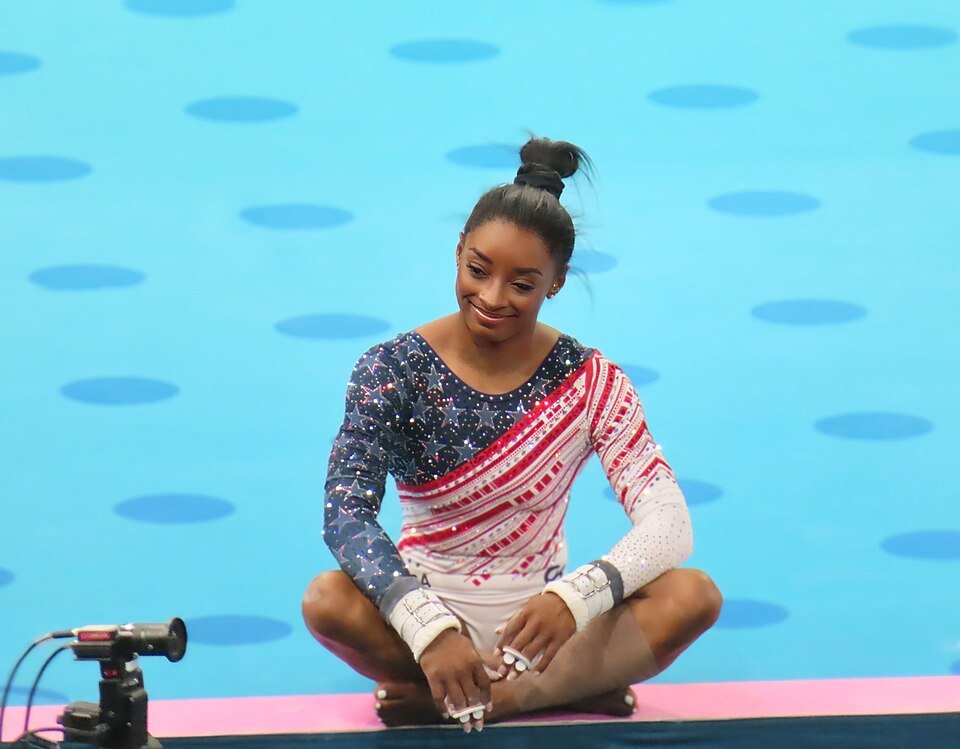
Photo: Image source Ocoudis, Wikimedia Commons, CC0 1.0: https://commons.wikimedia.org/wiki/File:Simone_Biles_Paris_Olympics.jpg
Photo: Ocoudis / Wikimedia Commons · CC0 1.0 · Paris, 30 July 2024. Original image; no alterations by ETERVOXIA.

Few Olympic performances are remembered solely for their medals. Simone Biles’s appearance at Paris 2024 was also a story about competitive excellence, career longevity, and the freedom of an athlete to return to elite sport on their own terms. By the end of the Games, the American gymnast had added four medals to her record and brought her Olympic total to eleven. The number matters, but so does the journey behind it.
A comeback measured in competition
In Paris, Biles helped the United States win the women’s artistic gymnastics team title. She then won the individual all-around gold and vault gold before earning silver on floor exercise. The sequence brought her Paris tally to three golds and one silver, making the Games one of the most successful chapters of her Olympic career. The U.S. federation confirmed that the floor medal was her eleventh Olympic medal overall.
These outcomes were not automatic. Elite gymnastics demands a difficult combination of precision, explosive power and composure: a single landing or a small lapse in body alignment can alter the medal order. What distinguished Biles in Paris was not simply the ambition of her routines, but her ability to execute enough of that difficulty across several demanding competitions.
What her Olympic record actually says
Across Rio 2016, Tokyo 2020 and Paris 2024, Biles has won seven Olympic gold medals, two silver medals and two bronze medals. Her seven golds include four from Rio and three from Paris. This is a record of repeated success at different stages of an athlete’s development, rather than one exceptional fortnight. It also provides an unusually clear way to compare the durability of elite performance across separate Olympic cycles.
The medal count should not eclipse the quality of the wider sporting context. The women’s field continued to develop as Biles competed, while the rules and demands of gymnastics rewarded both high-difficulty elements and clean execution. Her career is an example of how sport evolves around athletes who expand what competitors attempt.
A more useful definition of sporting legacy
A legacy is not just a list of podium finishes. It includes the technical standards an athlete establishes, the expectations they reshape and the conversations their choices make possible. Biles’s return to the Olympic stage illustrates that success can be accompanied by careful decisions about preparation, readiness and personal agency.
For emerging gymnasts, the lessons are practical: mastery comes from years of repetition, difficulty must be matched by control, and sustainable performance requires attention to both skill and wellbeing. The Paris results offer a remarkable sporting reference point without suggesting that every athlete should follow the same path.
Why the story continues to matter
Paris 2024 supplied a documented milestone: four medals in one Games and eleven Olympic medals in total. But the more enduring contribution may be the standard Biles set for how an athlete can pursue excellence across multiple phases of a career. That is a legacy worth examining with reliable records, respectful context and an understanding that the person is more than the result.
Sources and verification
- USA Gymnastics — Biles wins 11th Olympic medal (5 August 2024)
- USA Gymnastics — Historical U.S. Olympic medal results
- Olympedia — Simone Biles Olympic results and biography